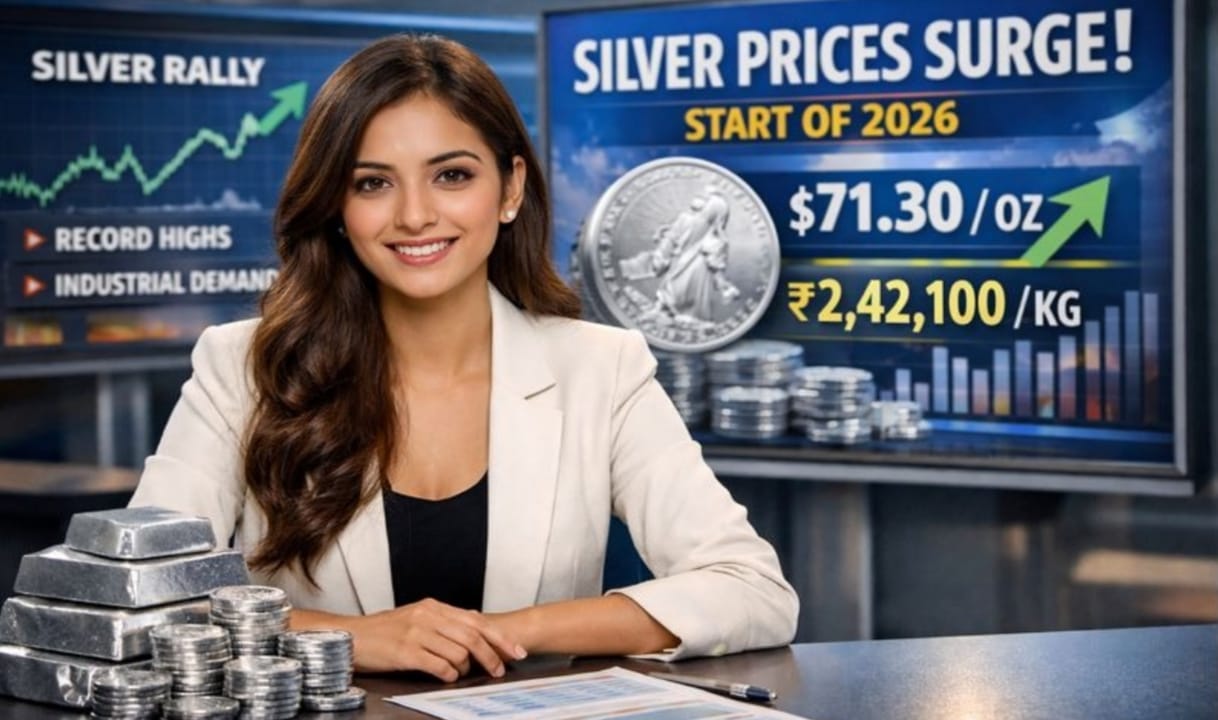
The beginning of 2026 has brought remarkable momentum to the global silver market. After delivering a record-breaking performance throughout 2025, silver prices continue to move upward with strong conviction. As of January 3, 2026, silver is trading close to $71.30 per ounce in international markets, while in India, prices have surged to approximately ₹2,42,100 per kilogram. This dramatic rise has captured the attention of investors, analysts, and industry participants worldwide.
⚠️ Disclaimer
This article is written for informational and educational purposes only. The prices, market trends, and analysis related to silver mentioned in this post are based on publicly available information and market observations at the time of writing.
This is not financial or investment advice. Silver prices are highly volatile and may change due to global economic factors, interest rates, and market demand. Readers are advised to consult a certified financial advisor before making any investment decisions.
The author and the website will not be responsible for any financial loss or gain arising from the use of information provided in this article.
Silver’s recent performance is not just a short-term spike. It reflects deep structural changes in global demand, supply constraints, and evolving monetary conditions. Many market experts believe that silver has entered a new phase, driven by both its role as a precious metal and its growing importance as an industrial commodity.
A Historic Rally: Silver’s Exceptional Performance in 2025
Silver delivered one of its strongest annual performances in modern history during 2025, registering an astonishing 148% return. This marks the metal’s best yearly gain since the 1970s, when inflationary pressures and economic uncertainty drove precious metals to historic highs.
Unlike previous rallies that were primarily fueled by speculative demand, the 2025 surge was backed by real, sustained industrial consumption. Investors increasingly began to view silver not only as a hedge against inflation and currency depreciation but also as a critical material for future technologies.
This combination of investment demand and industrial usage has created a powerful price momentum that continues into early 2026.
Rising Industrial Demand: The Biggest Growth Driver
One of the most important reasons behind silver’s strength is the rapid expansion of industrial demand, particularly in high-growth sectors.
Solar Energy Sector
Silver plays a vital role in the manufacturing of solar panels, where it is used in photovoltaic cells for efficient electricity conduction. As countries accelerate their shift toward renewable energy to meet climate goals, solar installations have increased sharply. This has directly boosted silver consumption on a global scale.
Electric Vehicles (EVs)
The electric vehicle industry is another major consumer of silver. EVs require significantly more silver than traditional internal combustion engine vehicles due to their advanced electrical systems, batteries, and charging infrastructure. With global EV adoption rising year after year, silver demand continues to expand rapidly.
Electronics and Technology
Silver is widely used in electronics due to its superior conductivity. From smartphones and laptops to advanced medical devices and 5G infrastructure, silver remains irreplaceable in many applications. The growth of artificial intelligence, automation, and digital infrastructure further strengthens long-term demand.
Interest Rates and Monetary Policy: A Supportive Environment
Monetary policy expectations have also played a crucial role in silver’s rally. The U.S. Federal Reserve has signaled the possibility of interest rate cuts during 2026, as inflation shows signs of stabilizing and economic growth moderates.
Lower interest rates typically benefit precious metals like silver and gold because:
- The opportunity cost of holding non-yielding assets decreases
- The U.S. dollar tends to weaken, making commodities cheaper for global buyers
- Investors seek alternative stores of value during uncertain economic conditions
As a result, both institutional and retail investors have increased their exposure to silver.
Supply Constraints: A Growing Challenge
While demand continues to rise, silver supply remains under pressure. Global mining output has struggled to keep pace due to several factors:
- Declining ore grades at major mines
- Reduced investment in new mining projects over the past decade
- Environmental regulations and operational challenges
- Depletion of older above-ground silver inventories
Many silver mines primarily produce silver as a by-product of other metals such as zinc, lead, and copper. This limits the ability of producers to rapidly increase silver output in response to higher prices. The result is a tight supply-demand balance that strongly supports higher prices.
Impact on Indian Silver-Related Stocks
Rising silver prices have had a direct and positive impact on several Indian companies connected to silver production and investment.
Hindustan Zinc
Hindustan Zinc is one of the world’s leading silver producers and ranks among the top three globally. With silver prices at elevated levels, the company has seen a significant boost in profitability. Strong cash flows and improved margins have made Hindustan Zinc an attractive stock for metal investors.
Vedanta
Vedanta holds a major stake in Hindustan Zinc, which means it indirectly benefits from rising silver prices. The positive performance of its subsidiary has strengthened Vedanta’s overall financial outlook and supported its share price momentum.
Silver Exchange-Traded Funds (ETFs)
For investors who prefer not to buy physical silver, Silver ETFs have emerged as a popular alternative. These instruments allow investors to gain exposure to silver prices through the stock market. Over the past few months, Silver ETFs in India have witnessed substantial inflows, reflecting growing investor confidence in the metal’s long-term prospects.
Volatility Remains: What Investors Should Know
Despite the strong bullish trend, silver remains a highly volatile asset. Price swings can be sharp due to changes in global economic data, central bank decisions, or sudden shifts in investor sentiment.
Market analysts suggest that while the long-term outlook for silver remains positive in 2026, investors should:
- Avoid chasing prices during sharp rallies
- Consider a buy-on-dips strategy
- Maintain proper risk management and diversification
- Invest with a medium- to long-term perspective
Silver’s dual nature as both an industrial metal and a precious metal means it can react quickly to both economic growth signals and financial uncertainty.
Outlook for 2026: Is the Rally Sustainable?
Most analysts believe that silver still has room to grow in 2026, supported by:
- Continued expansion in renewable energy and EV markets
- Potential interest rate cuts globally
- Ongoing supply limitations
- Rising investor awareness and participation
However, they also caution that temporary corrections are likely along the way. Long-term investors who understand silver’s fundamentals and remain patient may find attractive opportunities during market pullbacks.
Conclusion
Silver has firmly established itself as one of the strongest-performing assets entering 2026. Its exceptional rally is driven by powerful long-term trends rather than short-term speculation. With rising industrial demand, supportive monetary conditions, and constrained supply, silver continues to shine as both an investment and a strategic industrial metal.
For investors willing to navigate its volatility with discipline, silver may remain a valuable addition to portfolios in the year ahead.
